This simply works as a guide and helps you to connect with the doctor of your choice. Please confirm the doctor’s availability before leaving your premises.
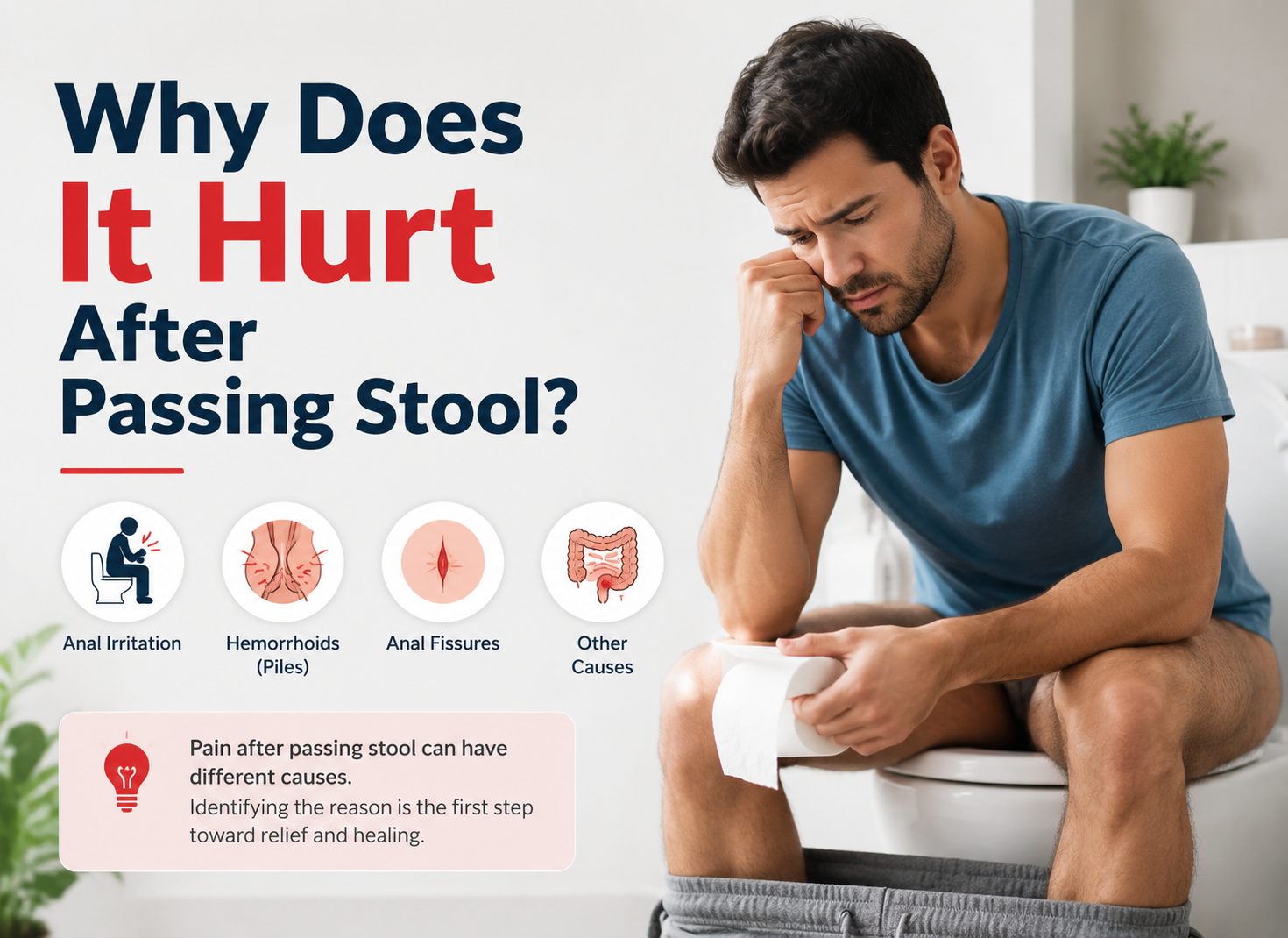
If you wince every time you visit the toilet — or dread going altogether — you are not alone. Pain after passing stool is one of the most common yet under-reported health complaints in India. Many people silently suffer for months, assuming it will go away on its own. Sometimes it does. Often, it doesn’t.
The most frequent cause of this sharp, burning discomfort is a condition called ananal fissure — a small tear in the lining of the anal canal. While it sounds minor, it can significantly affect your daily quality of life.
This guide explains what anal fissures are, why they cause pain, what makes them worse, and what you can do about them.
An anal fissure is a small cut or tear in the thin, moist tissue (mucosa) that lines the anal canal. Think of it like a paper cut — except in one of the most sensitive parts of your body.
Because the anal canal has a dense network of nerve endings, even a tiny tear can causedisproportionately intense pain, especially during and after a bowel movement.
Anal fissures can affect people of any age — including infants and young adults — and are equally common in men and women.
The pain pattern of an anal fissure is quite distinctive and follows a predictable sequence:
During the bowel movement — you feel a sharp, tearing or cutting sensation as stool passes over the fissure.
Immediately after — the pain may intensify for a few minutes.
30 minutes to 2 hours after — a prolonged burning or throbbing pain sets in. This is caused by spasm of the internal anal sphincter muscle, which tightens reflexively in response to the tear.
This sphincter spasm is actually the main reason anal fissures are so painful and why they take a long time to heal — the spasm reduces blood supply to the area, slowing natural tissue repair.
The primary cause is trauma to the anal lining, usually from:
1. Hard or Large Stools (Constipation) The most common trigger. Straining to pass a large, dry stool creates excessive pressure on the anal canal wall, causing a tear.
2. Chronic Diarrhoea Frequent, loose stools repeatedly irritate and inflame the delicate anal tissue, eventually breaking it down.
3. Childbirth Women who have given birth vaginally are at significantly higher risk. The pressure and stretching during delivery can cause fissures.
4. Anal Intercourse Friction and trauma can cause tears in the anal lining.
5. Low-Fibre Diet A diet lacking in fibre leads to harder, bulkier stools — a leading risk factor for both constipation and fissures.
6. Reduced Blood Flow Older adults may develop fissures due to reduced circulation to the anorectal area.
7. Inflammatory Bowel Disease (IBD) Conditions like Crohn’s disease can cause chronic anal fissures as part of their wider gut inflammation.
Acute vs. Chronic Anal Fissure — Know the Difference
Feature
Acute Fissure
Chronic Fissure
Duration
Less than 6 weeks
More than 6–8 weeks
Appearance
Fresh, clean tear
Fibrosed edges, sentinel pile
Likely Cause
Single trauma event
Repeated injury or poor healing
Self-healing
Often possible
Rarely heals without treatment
Treatment
Diet + topical creams
Medical or laser intervention
An acute fissure can become chronic if left untreated. Chronic fissures develop hardened, thickened edges and often come with a sentinel skin tag at the lower end — a sign that the body has been trying (and failing) to heal.
Acute fissures — yes, sometimes. With adequate hydration, a high-fibre diet, sitz baths, and stool softeners, many fresh fissures resolve within a few weeks.
Chronic fissures — rarely without medical intervention. Once the tissue has become fibrotic and the sphincter spasm is persistent, topical treatments and diet changes alone are usually insufficient.
Home Remedies That Can Help (For Mild Cases)
For early-stage or acute fissures, the following can provide relief and support healing:
Increase dietary fibre — 25–35g per day through fruits, vegetables, whole grains, and lentils
Drink 2.5–3 litres of water daily to keep stools soft
Warm sitz baths for 15–20 minutes, 2–3 times a day — reduces sphincter spasm and promotes blood flow
Avoid straining — never hold your breath or push hard during a bowel movement
Topical anaesthetic creams — can provide temporary pain relief (consult a doctor before use)
Stool softeners — help ease passage without straining
Conservative Treatment Fibre supplements, stool softeners, sitz baths, and topical creams (GTN, diltiazem, or lignocaine-based) are the first line for acute fissures.
Botox Injections Botulinum toxin injected into the internal anal sphincter reduces muscle spasm, temporarily allowing the fissure to heal. It is effective but may need to be repeated.
Laser Treatment (LIS — Laser Internal Sphincterotomy) For chronic, non-healing fissures, laser-assisted internal sphincterotomy is a minimally invasive option. The procedure:
Takes 20–30 minutes under local or short general anaesthesia
Involves a precise laser incision to release the sphincter spasm
Requires no hospital overnight stay — same-day discharge in most cases
Has a low recurrence rate compared to open surgery
Is covered under cashless insurance with 35+ insurers
At LaserQure, laser treatment for anal fissure is performed by Dr. Ram Bhupal Rao, a Plastic & Laser Surgeon with extensive experience in laser proctology at Anupama Hospitals, Kukatpally, Hyderabad.
No. Piles are swollen blood vessels inside or around the rectum. An anal fissure is a tear in the anal lining. They can coexist but are different conditions requiring different treatments.
The procedure is performed under anaesthesia, so there is no pain during the surgery. Post-procedure discomfort is mild and manageable with medication.
Yes — at LaserQure, anal fissure laser treatment is covered under cashless insurance with over 35 insurance providers, including major government and private schemes.
In most cases, yes. Laser fissure treatment at LaserQure is typically a day-care procedure with same-day discharge.
Q7. What foods should I avoid if I have an anal fissure? Avoid spicy foods, refined flour (maida), red meat, alcohol, and low-fibre processed foods. Focus on fruits, vegetables, oats, and adequate water intake.
LaserQure at Anupama Hospitals, Kukatpally, offers laser treatment for anal fissures performed by Dr. Ram Bhupal Rao. The procedure is minimally invasive, covered under cashless insurance with 35+ providers, and typically involves same-day discharge.
Conclusion
Pain after passing stoolis not something you have to accept as normal or simply endure. In most cases, it signals an anal fissure — a treatable condition. Early diagnosis and appropriate management can resolve it quickly, while delaying care can turn a simple fissure into a chronic, recurring problem.
If you’ve been experiencing these symptoms for more than a few weeks, a consultation with a laser proctology specialist can help identify the right course of treatment and get you back to comfortable, pain-free living.