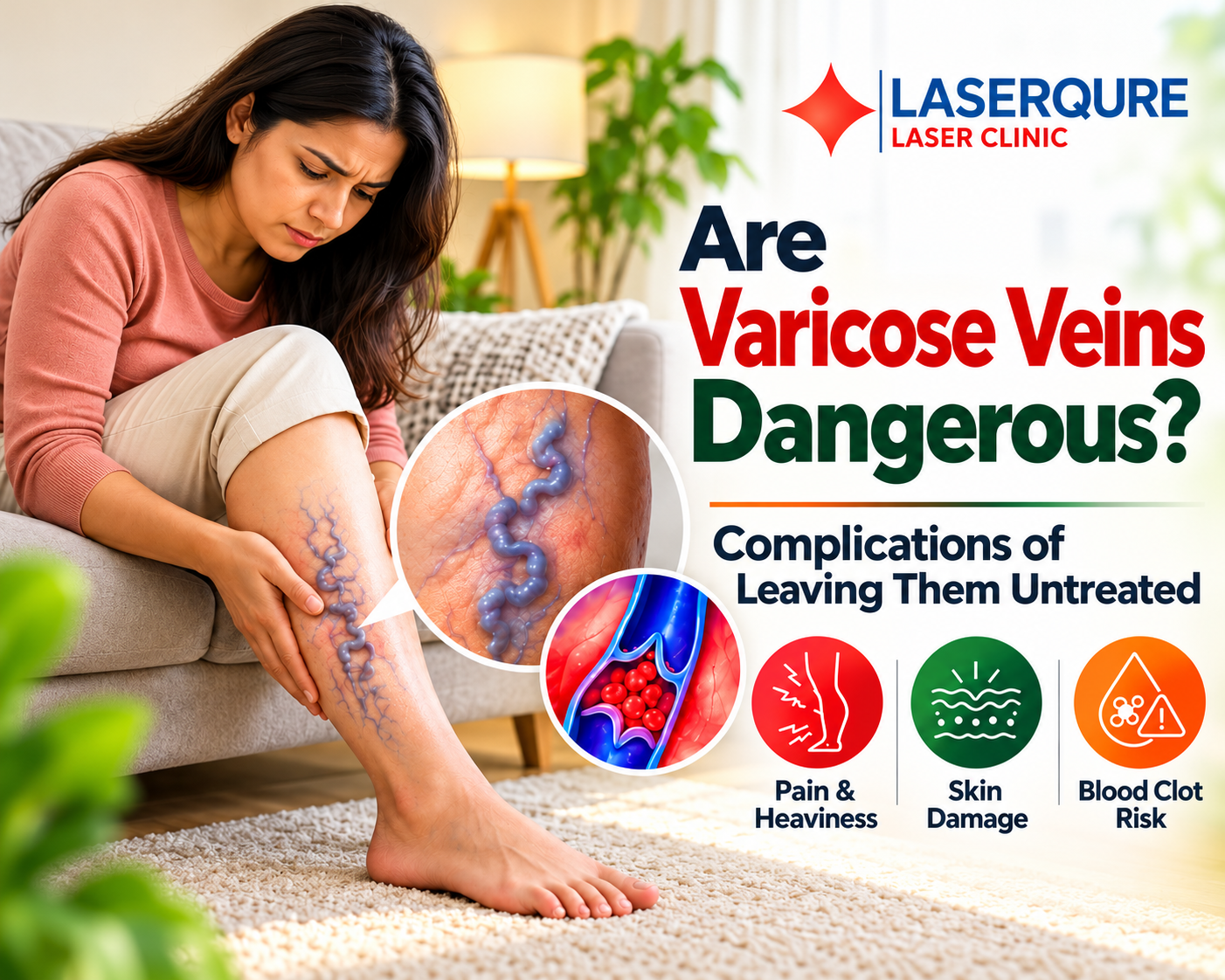
Are Varicose Veins Dangerous? Complications of Leaving Them Untreated
Many people look at the swollen, twisted veins on their legs and think, “It’s just a cosmetic problem.” So they hide their legs, put up with the heaviness and keep postponing treatment for years.
But are varicose veins dangerous? In the early stage they are usually not an emergency. However, they are a sign that the veins in your legs are not working properly. If they are left untreated, they can slowly lead to serious varicose veins complications such as skin damage, wounds that won’t heal, bleeding and blood clots.
In this blog, we explain why varicose veins should not be ignored, what can happen with untreated varicose veins, and how modern laser varicose veins treatment in Kukatpally, Hyderabad can help.
What Are Varicose Veins?
Varicose veins are enlarged, swollen and twisted veins, most often seen on the legs and calves. They usually look blue or purple and may bulge above the skin.
Healthy leg veins have small one-way valves that push blood back up towards the heart. When these valves become weak or damaged, blood flows backwards and collects in the veins. This raises the pressure inside the veins, so they stretch, swell and twist. Doctors call this chronic venous insufficiency.
Common Varicose Veins Symptoms
- Visible blue or purple bulging veins on the legs
- Heavy, aching legs, especially by evening
- Leg swelling around the ankles and feet
- Burning, throbbing or itching over the veins
- Night cramps in the legs
- Pain that gets worse after standing or sitting for long hours
- Relief when you raise your legs
Who Is at Risk of Varicose Veins?
- People whose jobs involve long standing, such as teachers, nurses, security staff, traffic police and shop workers
- IT professionals and office workers in Hitech City, Madhapur and Kukatpally who sit for long hours
- Women, especially during and after pregnancy
- People with a family history of varicose veins
- People who are overweight
- Older adults, because vein valves weaken with age
Are Varicose Veins Dangerous?
The honest answer: varicose veins are not just a cosmetic problem. They are a sign of poor blood flow in the legs, and if they are not treated they usually get worse over time.
Some people live with mild varicose veins for years without major trouble. In many patients, though, the constant high pressure in the veins slowly damages the skin and tissues of the legs. That is when varicose veins become dangerous.
8 Complications of Leaving Varicose Veins Untreated
1. Constant Pain and Leg Swelling
As the condition gets worse, so do the heaviness, pain and swelling. Many patients find it hard to stand at work, walk long distances or sleep well because of cramps.
2. Skin Discolouration
Blood pooling in the veins leaks into the surrounding tissue and causes dark brown or black patches on the lower legs and ankles. This darkening is often a warning sign that the disease is getting worse.
3. Venous Eczema
The skin over the veins may become dry, itchy, red and scaly. Scratching can break the skin and lead to infection.
4. Hardening of the Skin (Lipodermatosclerosis)
Over time, the skin and fat around the ankle may become thick, hard and tight. Doctors call this lipodermatosclerosis. It can be painful and shows that the veins have been damaged for a long time.
5. Venous Ulcers (Non-Healing Wounds)
One of the most serious varicose veins complications is a venous ulcer. This is an open wound, usually near the ankle, that heals very slowly and can keep coming back. Ulcers can be painful, can get infected and can disrupt daily life for months.
6. Bleeding from Varicose Veins
Veins close to the skin can become thin and fragile. A small injury, or even scratching, can cause sudden bleeding, which may be heavy. If this happens, lie down, raise the leg, press firmly on the spot and get medical help.
7. Superficial Thrombophlebitis
A blood clot can form in a varicose vein near the skin. This causes a painful, red, hard and warm cord along the vein and needs medical attention.
8. Deep Vein Thrombosis (DVT)
People with varicose veins may have a higher risk of deep vein thrombosis (DVT), which is a clot in the deeper veins of the leg. DVT can cause sudden swelling and pain in one leg. In rare cases, part of the clot can travel to the lungs (pulmonary embolism), which is a medical emergency.
Get emergency care immediately if you have sudden chest pain, breathlessness or are coughing up blood.
Warning Signs That Need Urgent Attention
See a varicose veins doctor quickly if you notice:
- Sudden swelling, pain or redness in one leg
- A wound near the ankle that is not healing
- Skin turning dark, hard or itchy
- Bleeding from a varicose vein
- A hard, painful lump along a vein
- Leg pain that stops you from walking or sleeping
Can Varicose Veins Go Away on Their Own?
Unfortunately, varicose veins do not go away on their own. Once the valves are damaged, they do not repair themselves. Walking, raising your legs and wearing compression stockings can ease symptoms and slow things down, but they cannot fix the damaged veins.
Varicose Veins Treatment Options
1. Compression Stockings and Lifestyle Changes
Compression stockings, regular walking, weight control and raising the legs help reduce symptoms in the early stages. They help with comfort, but they do not close the damaged veins.
2. Traditional Vein Surgery
Older methods involve cutting out and removing the damaged vein (vein stripping). This can mean a longer hospital stay and a longer recovery.
3. Laser Varicose Veins Treatment (EVLA)
Endovenous laser ablation (EVLA) is a modern, minimally invasive varicose veins treatment, and many patients now prefer it.
How Laser Varicose Veins Treatment Works
- Doppler scan – An ultrasound scan maps the damaged veins.
- Local anaesthesia – The leg is numbed so the procedure is comfortable.
- Laser fibre insertion – A thin laser fibre is passed into the damaged vein through a tiny needle puncture.
- Vein closure – Laser energy seals the faulty vein from the inside.
- Natural rerouting – Blood automatically flows through the healthy veins, and the body slowly absorbs the closed vein.
Benefits of Laser Varicose Veins Treatment
- No big cuts or stitches, just a tiny puncture
- Minimal pain and bruising
- Same-day discharge
- You can walk soon after the procedure
- Quick return to work and daily routine
- Minimal scarring and good cosmetic results
Learn more in our blog on Laser vs Surgery for Varicose Veins.
Why Choose LaserQure for Varicose Veins Treatment in Kukatpally?
Patients looking for the best varicose veins doctor in Hyderabad choose LaserQure, at Anupama Hospitals, JNTU Road, near Nexus Mall, Kukatpally, for:
- Expert care led by Dr. Ram Bhupal Rao, general surgeon (Kasturba Medical College, Manipal) with specialisation in plastic and cosmetic surgery (Gandhi Medical College, Hyderabad)
- Female surgeon option, including Dr. Srujana Gorle, MS (General Surgery), MCh (Plastic Surgery)
- Advanced laser treatment with no big cuts
- Sterile, state-of-the-art operation theatre and on-site laboratory
- Same-day treatment and same-day discharge
- Cashless insurance and 0% EMI facility
- Convenient varicose veins treatment in KPHB, Kukatpally, Miyapur, Nizampet and Hitech City
Learn more about our varicose veins treatment in Hyderabad.
Frequently Asked Questions (FAQs)
1. Are varicose veins dangerous? In the early stage they are usually not an emergency. If they are left untreated, they can lead to skin damage, ulcers, bleeding and blood clots.
2. Can varicose veins cause blood clots? Yes. They can lead to clots in the surface veins and may raise the risk of deep vein thrombosis (DVT).
3. Do varicose veins go away on their own? No. Damaged vein valves do not repair themselves, though lifestyle changes can ease symptoms.
4. Is laser varicose veins treatment painful? It is done under local anaesthesia, and most patients feel only mild discomfort.
5. How soon can I walk after laser varicose veins treatment? Most patients walk soon after the procedure and go home the same day.
6. Can varicose veins come back after laser treatment? Laser treatment gives good long-term results for the treated veins. New varicose veins can still form over time, so regular walking, weight control and avoiding long standing help.
7. Is a female doctor available for varicose veins treatment? Yes. Women patients can choose a female surgeon at LaserQure.
8. Is varicose veins treatment covered by insurance? Yes. LaserQure offers cashless insurance with major insurers and a 0% EMI option.
Conclusion
So, are varicose veins dangerous? They may start as a cosmetic concern, but untreated varicose veins can lead to pain, skin damage, ulcers, bleeding and blood clots. The earlier you treat them, the simpler the treatment and the better the results.
Don’t wait for complications. Get expert laser varicose veins treatment in Kukatpally at LaserQure.
Book your consultation today:
📍 LaserQure, Anupama Hospitals, JNTU Road, Near Nexus Mall, Kukatpally, Hyderabad 📞 Call / WhatsApp: +91 88862 41919 ✉️ info@laserqure.com 🕒 Mon–Fri: 10 AM – 8 PM | Sat: 10 AM – 7 PM | Sun: Closed